Why acoustic panels fail quietly — and what it's costing you
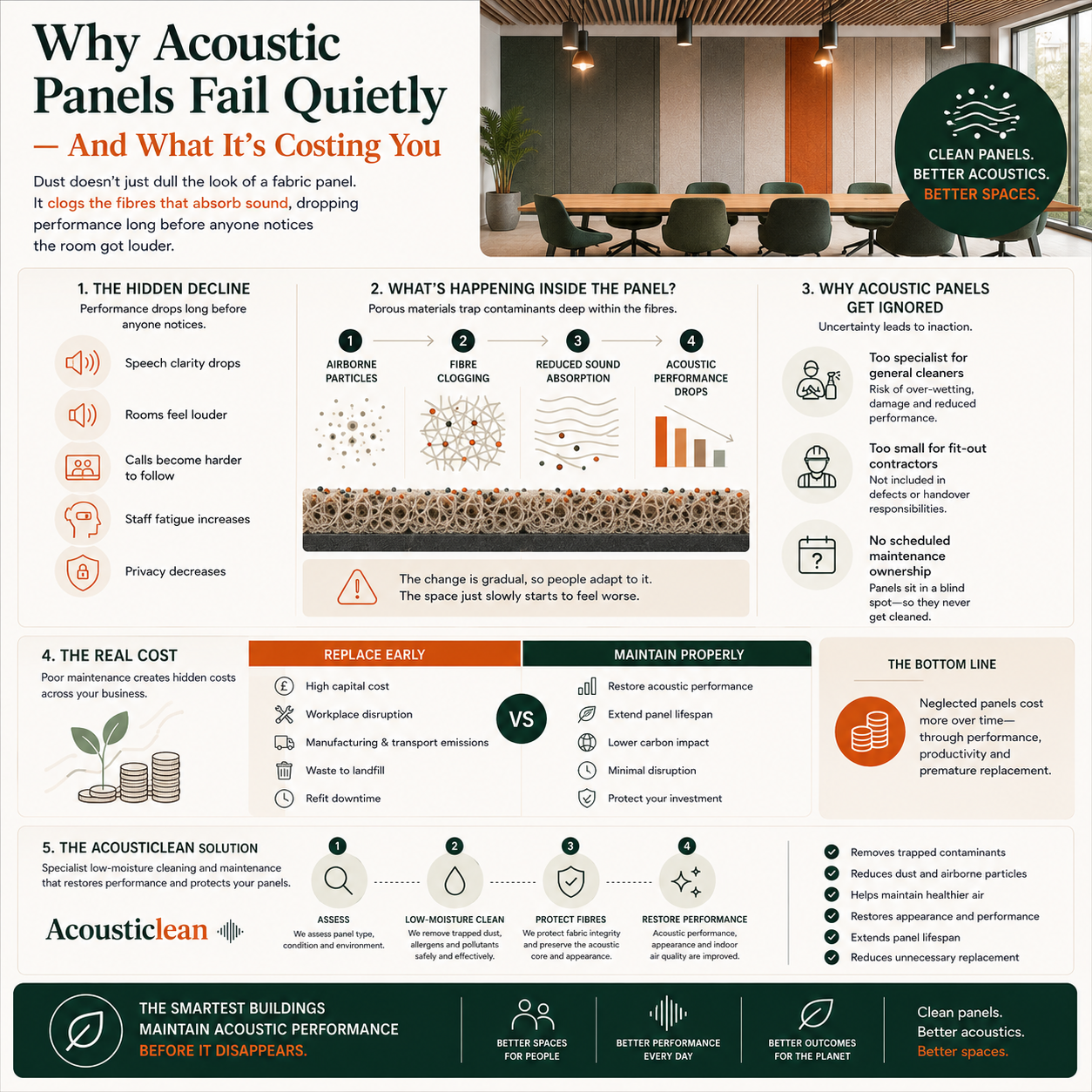
Dust doesn't just dull the look of a fabric panel. It clogs the fibres that absorb sound, dropping performance long before anyone notices the room got louder.
Most acoustic panel failures don't happen suddenly.
There's no dramatic breakage. No obvious warning sign. No maintenance alarm.
Instead, acoustic panels fail slowly, quietly, and almost invisibly.
And in many commercial spaces, the cost of that decline is far greater than most businesses realise.
The Problem Most Buildings Never Notice
Acoustic panels are installed to improve how a space performs.
They reduce reverberation. Improve speech clarity. Support concentration. Enhance comfort. Create calmer environments.
But over time, the very materials designed to absorb sound begin absorbing something else: dust.
Airborne particles gradually build up within the porous fibres of acoustic fabrics, PET materials, ceiling baffles, and acoustic rafts.
And while the panels may still look acceptable from a distance, their acoustic effectiveness quietly starts to decline.
The room slowly becomes:
- Harder to hear clearly
- More fatiguing to work in
- Less comfortable for meetings
- Worse for video calls
- More distracting overall
The problem is gradual enough that most workplaces simply adapt to it.
People speak louder. Meetings become more draining. Background noise increases. Speech privacy drops.
Nobody notices the exact moment performance changed. The space just slowly starts to "feel worse".
Dust Doesn't Just Affect Appearance
One of the biggest misconceptions around acoustic panels is that maintenance is purely cosmetic. It isn't.
Dust doesn't just sit on the surface of an acoustic panel. It penetrates deep into the fabric weave and absorbing core — precisely where sound energy is supposed to be dissipated.
As contamination builds up:
- Fibres become clogged
- Sound absorption efficiency drops
- Reverberation increases
- Speech intelligibility declines
- Acoustic comfort reduces
In effect, the panel gradually stops performing the job it was installed to do.
The irony? Businesses often spend significant budgets improving workplace acoustics during fit-outs — only to unintentionally let those systems degrade through lack of maintenance.
Why Acoustic Panels Get Ignored
The issue isn't usually neglect. It's uncertainty.
Most facilities teams understand that acoustic panels are delicate specialist materials.
And because standard cleaning methods can damage them, many panels simply get left alone entirely.
General cleaning contractors often avoid them because:
- Over-wetting can distort fibres
- Aggressive cleaning can damage surfaces
- Incorrect methods can reduce acoustic performance
- Delicate fabrics require specialist care
As a result, acoustic systems frequently fall into a maintenance blind spot. Not cleaned. Not assessed. Not maintained. Until replacement eventually feels unavoidable.
The Hidden Financial Cost
Poor acoustic maintenance creates costs in multiple ways simultaneously.
Reduced Workplace Performance
Poor acoustics affect concentration, communication, and fatigue more than most organisations realise.
In noisy or acoustically degraded environments:
- Meetings become less productive
- Hybrid calls become harder to follow
- Employees experience greater cognitive fatigue
- Privacy decreases
- Focus suffers
And because these impacts are difficult to measure directly, they are often ignored.
Early Replacement Costs
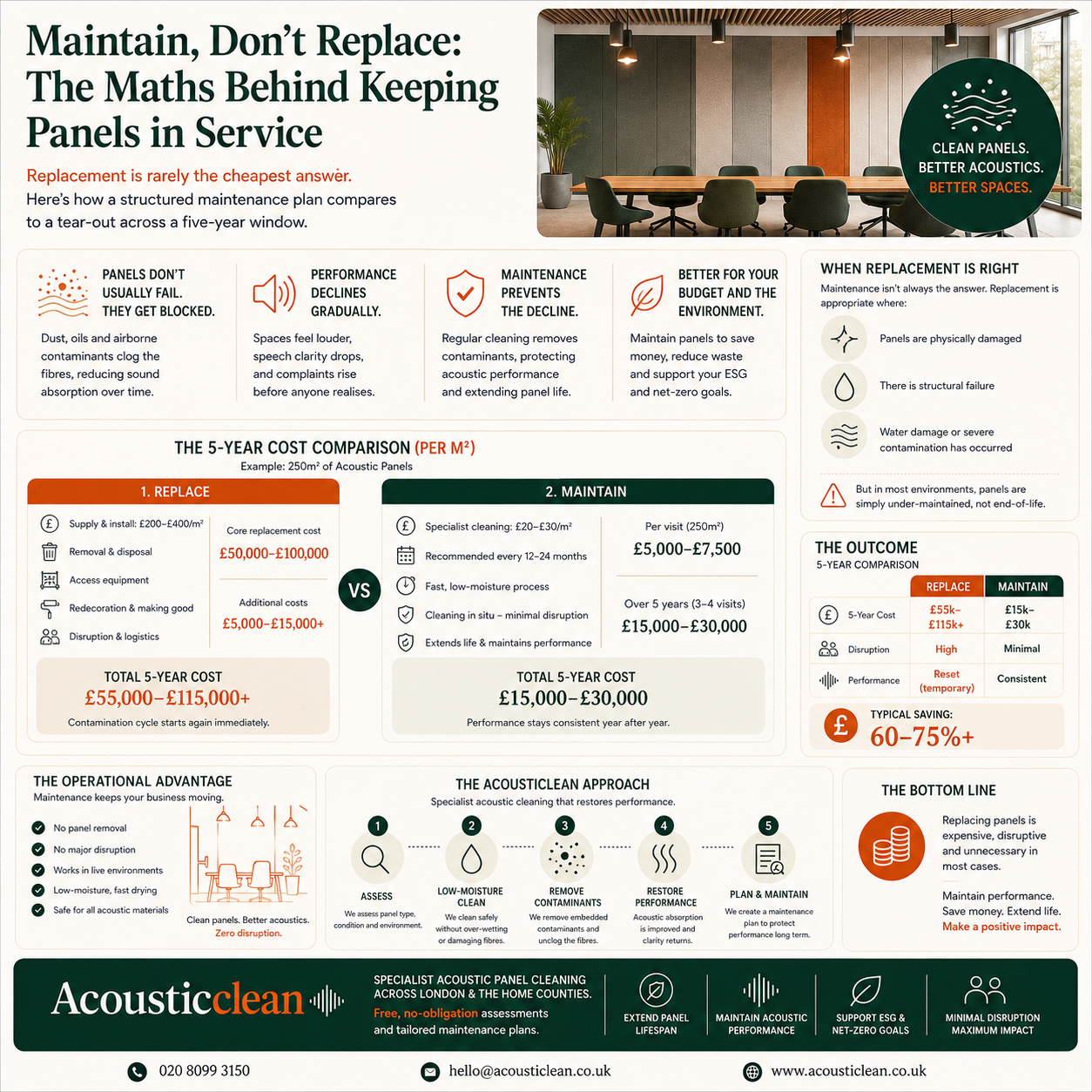
Many acoustic systems are replaced years before the materials themselves have actually reached end of life.
Why? Because they look tired, contaminated, or underperforming.
In reality, many panels simply need specialist restoration and maintenance.
Full replacement can involve:
- Significant capital expenditure
- Workplace disruption
- Manufacturing and transport emissions
- Unnecessary landfill waste
Most of which can often be avoided through preventative care.
Damage to Workplace Perception
Acoustic panels are often highly visible architectural features.
When they become dusty, stained, faded, or tired-looking, they subtly affect how the entire space is perceived.
Visitors may not consciously identify the panels themselves. But they notice the environment feels less clean, less premium, and less cared for.
Why Specialist Acoustic Maintenance Matters
Acoustic materials are not painted walls.
They require specialist maintenance methods specifically designed to preserve:
- Fabric integrity
- Acoustic performance
- Material lifespan
- Appearance
- Indoor environmental quality
At Acousticlean, our specialist low-moisture cleaning process is designed to restore acoustic systems without damaging the absorbing core underneath.
Our approach helps:
- Remove trapped dust and contaminants
- Restore appearance
- Improve acoustic performance
- Extend panel lifespan
- Reduce unnecessary replacement
- Support healthier indoor environments
Most importantly, it allows businesses to protect the performance of their acoustic investment without disruptive replacement programmes.
Maintain Before Performance Drops
The biggest mistake most buildings make is waiting until acoustic panels visibly look bad before taking action.
By that stage, acoustic performance may already have been compromised for years.
The smarter approach is preventative maintenance.
Because acoustic panels shouldn't only look good. They should continue performing properly too.
The smartest buildings aren't replacing acoustic assets early. They're maintaining them before performance quietly disappears.