Acoustic panel care belongs in your ESG report
Diverting panels from landfill is a measurable sustainability win. We unpack what to track and how to evidence it for annual reporting.
Sustainability reporting has moved well beyond energy use and recycling bins.
Today, ESG reporting is about asset lifecycle, material efficiency, and measurable impact — and that includes the built environment in far more detail than ever before.
Yet one category is consistently overlooked: acoustic panels.
Across offices, commercial spaces, and public buildings, thousands of square metres of acoustic material are replaced every year — often unnecessarily.
For facilities managers and ESG leads, this presents a clear opportunity: extend panel life, reduce waste, and create a measurable sustainability gain.
The Hidden Waste Stream in Commercial Buildings
Acoustic panels are rarely included in sustainability conversations. Why? Because they sit in a blind spot between:
- Fit-out contractors
- Facilities management
- Cleaning and maintenance
The result:
- Panels degrade visually or acoustically
- They’re assumed to be “end of life”
- They’re removed and replaced
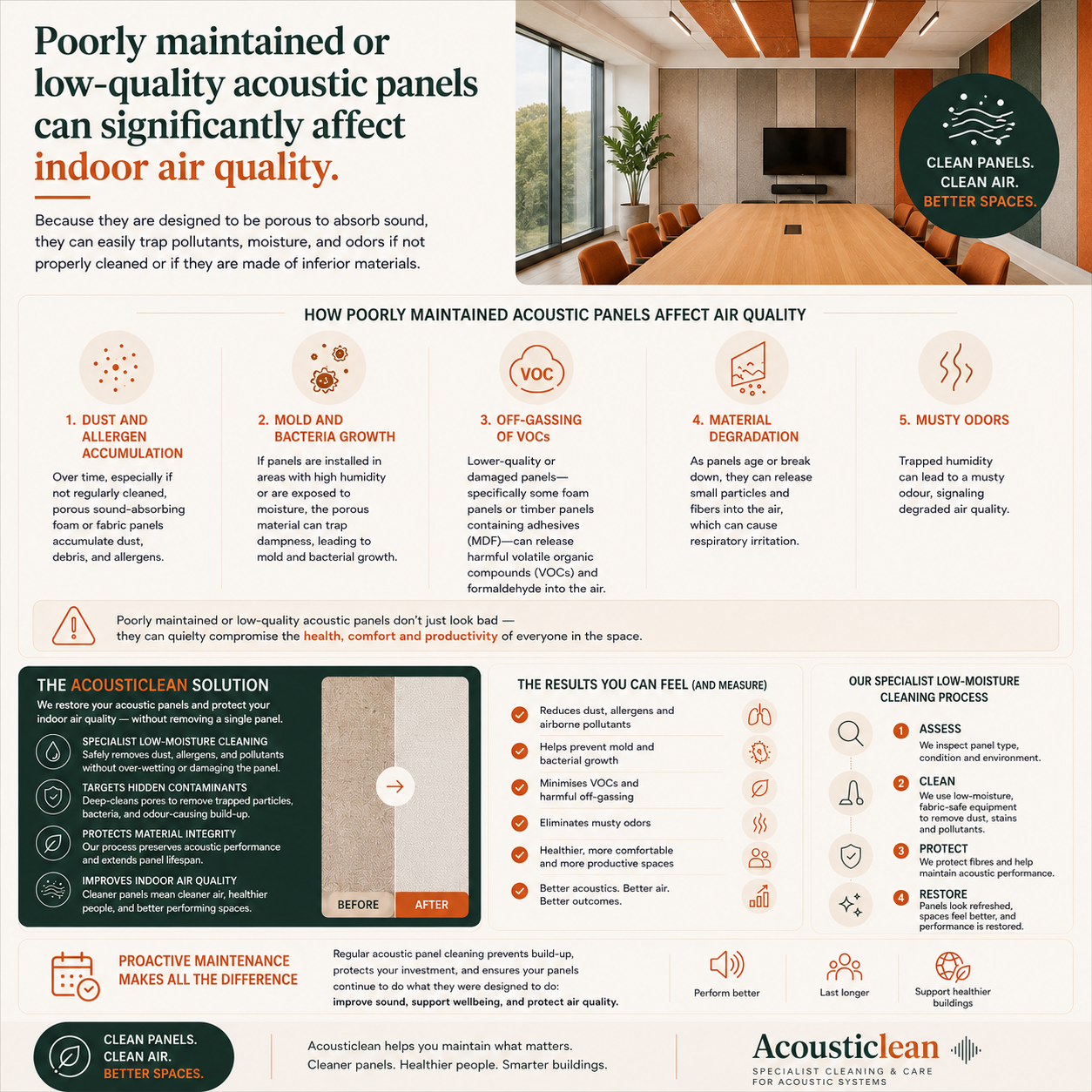
In reality, most panels are not defective — they’re simply contaminated and under-maintained.
The ESG Impact of Replacement
When panels are replaced, the environmental cost is significant:
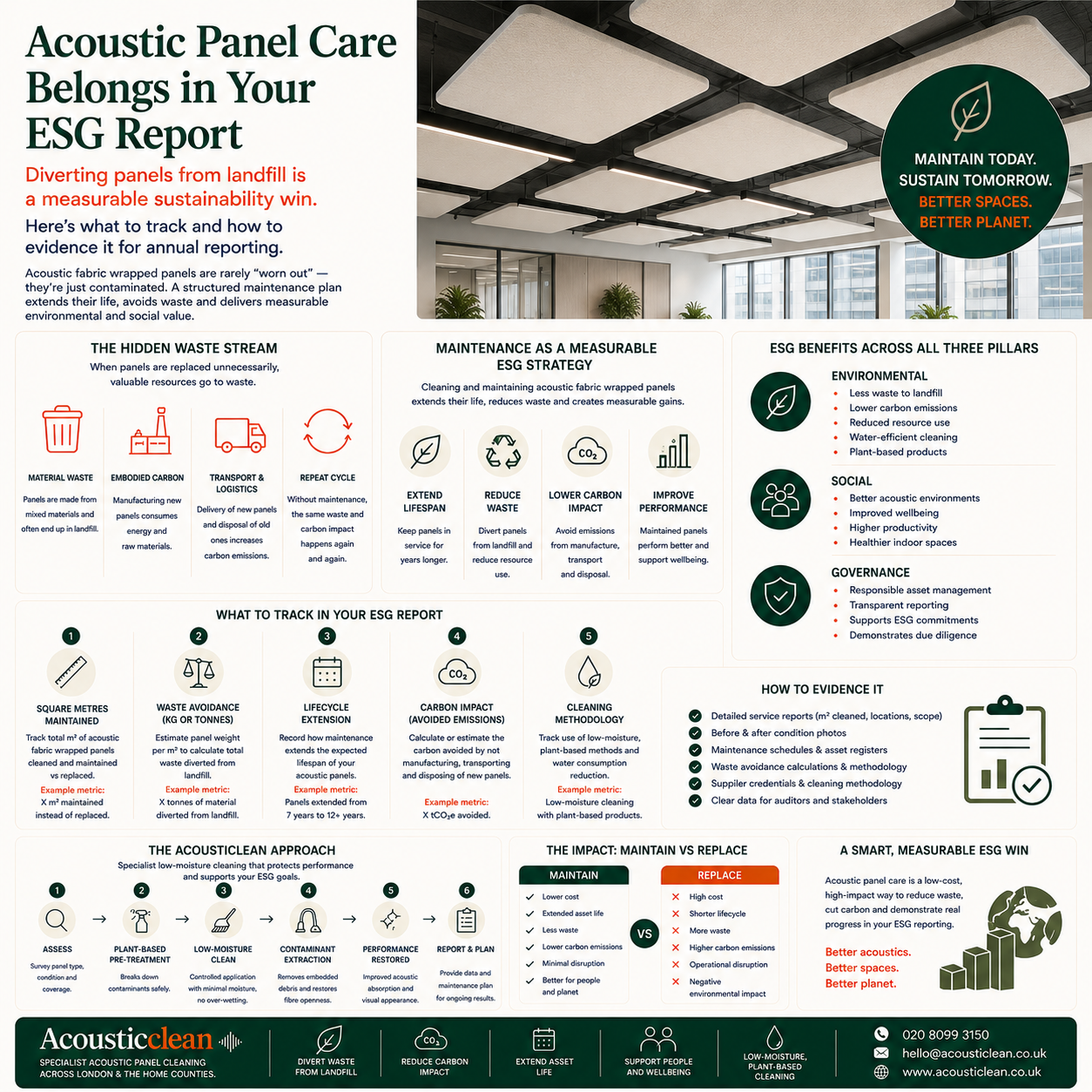
1. Material Waste
- Fabric, foam, mineral cores, and backing boards
- Often bonded materials — difficult to recycle
- Typically sent to landfill or energy recovery
2. Embodied Carbon
- Manufacturing new panels
- Raw material extraction
- Fabrication and finishing
3. Transport and Logistics
- Delivery of new panels
- Removal and disposal of old materials
- Multiple supply chain touchpoints
4. Repeat Cycle
Without maintenance, the same process repeats every 5–10 years — or sooner.
Maintenance as a Measurable ESG Strategy
Acoustic panel cleaning isn’t just a maintenance task — it’s an asset lifecycle strategy.
By introducing a structured maintenance plan, organisations can:
- Extend panel lifespan significantly
- Avoid premature replacement
- Reduce waste generation
- Lower embodied carbon impact
And crucially — these outcomes are measurable.
What Should You Be Tracking?
To include acoustic panel care in ESG reporting, the focus should be on quantifiable metrics.
1. Square Metres Maintained vs Replaced
Track:
- Total m² of acoustic panels in your estate
- m² cleaned and maintained annually
- m² replaced
This creates a clear narrative: “X m² of acoustic material diverted from replacement through maintenance.”
2. Waste Avoidance (kg or tonnes)
Estimate the material weight per m² of panel systems. From this, you can report total waste avoided by maintaining instead of replacing.
This is particularly valuable for:
- Scope 3 emissions reporting
- Waste reduction targets
3. Lifecycle Extension
Track original expected lifespan vs extended lifespan through maintenance. Example: panels expected to last 7 years, maintained to 12+ years. This demonstrates resource efficiency — a key ESG indicator.
4. Carbon Impact (Avoided Emissions)
While exact figures vary, replacement has a clear carbon cost: manufacturing emissions, transport emissions, and disposal impact.
By maintaining instead of replacing, you can report avoided carbon associated with panel replacement. Even where precise carbon data isn’t available, proxy reporting is accepted when methodology is clear.
5. Cleaning Methodology
Not all cleaning supports ESG goals. Track:
- Use of low-moisture systems
- Use of plant-based, low-residue products
- Water consumption reduction vs traditional methods
This supports environmental compliance, indoor air quality standards, and sustainable procurement policies.
Evidence: What Auditors and Stakeholders Expect
It’s not enough to state outcomes — they need to be evidenced. A credible ESG narrative around acoustic panel care should include:
1. Service Reports
- Before and after condition records
- Scope of works (m² cleaned)
- Methodology used
2. Maintenance Schedules
- Planned cleaning intervals
- Asset registers showing panel locations and coverage
3. Waste Avoidance Calculations
- Clear methodology (e.g. estimated weight per m²)
- Total diverted material
4. Supplier Credentials
- Specialist contractor (not general cleaning)
- Defined low-moisture process
- Sustainable product usage
5. Visual Evidence
- Before/after imagery
- Condition improvement
- Proof of retained assets
Why Acoustic Panels Are an ESG “Quick Win”
Compared to major infrastructure upgrades, acoustic panel maintenance is:
- Low cost
- Fast to implement
- Immediately measurable
- Highly visible in reporting
It ticks multiple ESG boxes:
- Waste reduction
- Resource efficiency
- Carbon avoidance
- Workplace wellbeing
And importantly — it aligns facilities management with sustainability strategy.
The Workplace Impact (Beyond ESG)
There’s also a secondary benefit that often goes unreported: maintained panels perform better.
This improves:
- Speech clarity
- Workplace comfort
- Productivity
- Employee wellbeing
Which supports the “S” in ESG — Social impact.
The Risk of Doing Nothing
Without a maintenance strategy:
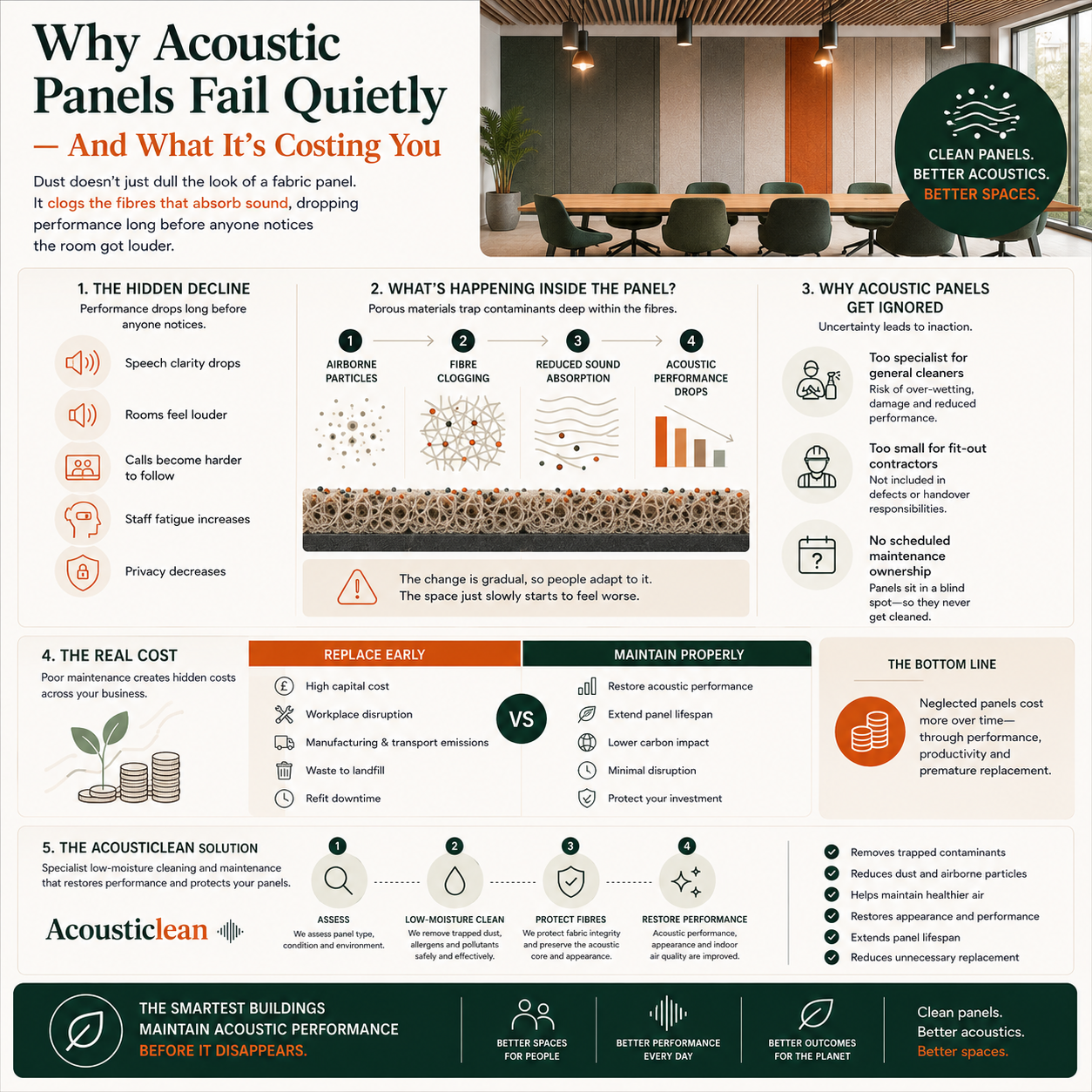
- Panels degrade unnoticed
- Performance drops
- Replacement becomes inevitable
- Costs and environmental impact increase
And critically — the opportunity to report meaningful ESG gains is lost.
The Acousticlean Approach
Acousticlean provides specialist acoustic panel cleaning designed to extend lifespan and support ESG outcomes. Our service is built around:
- Low-moisture cleaning systems (minimal water usage)
- Plant-based, low-residue products
- In situ cleaning (no removal or disposal)
- Detailed reporting and documentation
We don’t just clean panels — we help clients avoid replacement, reduce waste, and evidence sustainability outcomes.
Turning Maintenance Into Measurable Impact
Acoustic panel care is often overlooked because it’s seen as minor. But across a large estate, the numbers add up quickly:
- Hundreds of square metres
- Thousands of kilograms of material
- Significant embodied carbon
When maintained instead of replaced, this becomes a clear, reportable ESG success story.
The Bottom Line
Sustainability isn’t just about what you install — it’s about how long you keep it in service.
Acoustic panel maintenance delivers:
- Reduced waste
- Lower carbon impact
- Extended asset life
- Improved workplace environments
- Measurable ESG outcomes
Put Acoustic Panels Into Your ESG Strategy
If acoustic panels aren’t currently part of your ESG reporting, they should be. They represent a practical, measurable way to:
- Demonstrate resource efficiency
- Reduce environmental impact
- Align FM operations with sustainability goals
Get ESG-Ready Panel Maintenance Data
Acousticlean works with facilities teams across London and the Home Counties to deliver:
- Specialist acoustic panel cleaning
- Structured maintenance plans
- Reporting data suitable for ESG documentation
Get in touch for a free, no-obligation assessment — and start turning maintenance into measurable sustainability impact.